Across food politics media the debate rages:
organic or local? On the one hand, organic foods contain no pesticides, antibiotics, chemical by-products, or
risky genetic modifications. On the other, local foods don't pollute the environment or contribute to global climate change traveling hundreds of miles from farm to table; they support local farmers; and retain much more of their nutrient value by not languishing for days or weeks in trucks and storehouses. Both organic and local foods benefit the environment; both benefit human health. Which should be the priority - when you're standing in the produce aisle at Whole Foods, should you buy the organic artichokes from Brazil, or the conventional ones from a farm less than a hundred miles away?
The answer, increasingly, is that you don't have to choose, due to the rising popularity of
Community Supported Agriculture, or CSA (no, not the
Confederate States of America). Shares in a CSA can usually be purchased and/or exchanged for volunteer time assisting with farm work or distribution. CSA farmers are local and typically provide a weekly delivery or pick-up of a share of vegetables, fruits, and perhaps other farmed items like milk, yogurt, eggs, cheese, etc. Farms that provide CSAs are small-scale, often organic, and frequently utilize environmentally sound methods of production - resulting in both a healthier consumer and a healthier planet.

This is my second year participating in the Washington Square CSA, provided by
Norwich Meadows Farm in upstate New York.
(At right: Zaid, our farmer.) The CSA runs from mid-July to November and provides 7-12 lbs. of organic, seasonal veggies weekly for around $10/week. For additional cost, shares of fruit, milk, eggs, yogurt, cheese, and even chicken can be purchased. In fact, seasoned veterans of Pie in the Sky may remember one of my
first posts, which accounted for the varied uses of whole chickens that had accrued in the freezer over the course of the CSA (the chickens were fantastic, but we couldn't manage to eat one bi-weekly and I've got limited freezer space, so we won't be doing chicken this year).
Anyway, this year I'm splitting my share with J and new roomie W, and we've signed on for veggies, cheese, yogurt, and eggs. I've had the (amazing delicious perfect creamline) yogurt and the cheese before, but this is my first time with eggs, which are organic and free range and have fiery orange yolks - the result of healthy chicken diets full of vitamins. We got our first share on Wednesday (we walk a few blocks to pick it up) and have already made use of its bounty with omelettes, a fantastic salad, and this delicious
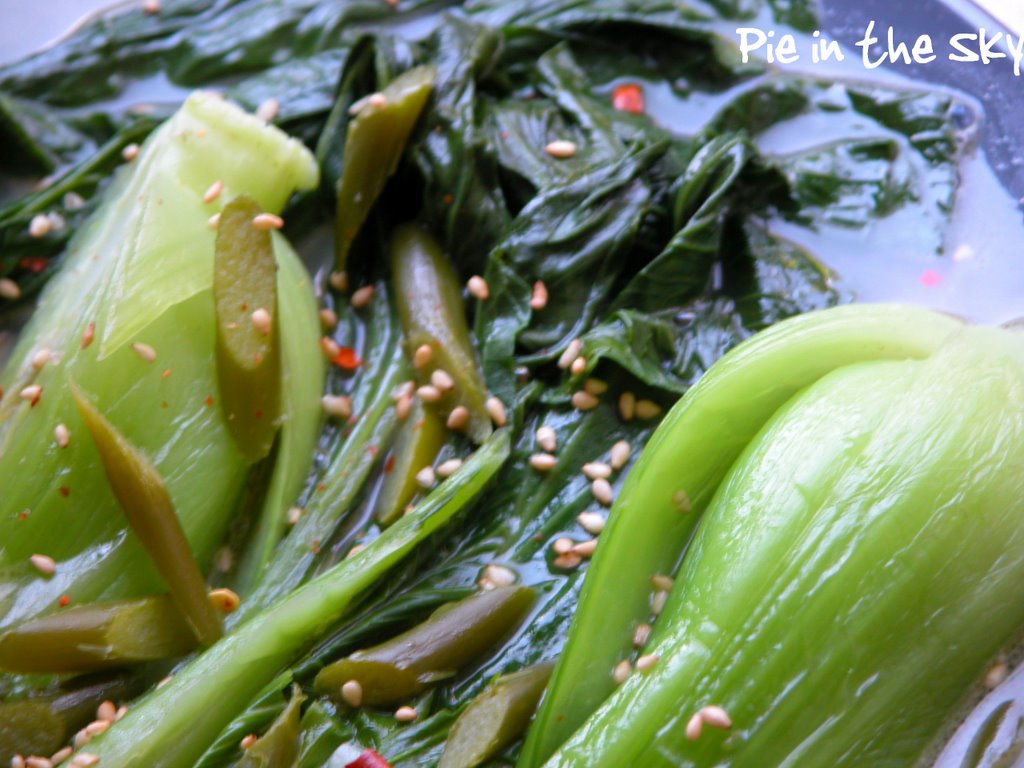
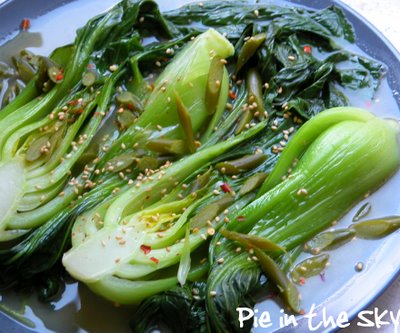
Braised Bok Choy with Garlic Scapes.
Before I tell you more about this recipe: what is a garlic scape? A scape is the tender stem of certain varieties of garlic that curls up and bears a pretty little seed-like bud. They're garlicky-tasting, but more subtle and buttery than garlic, and are usually
sautéed, put in pesto, or eaten raw in salads, but can also be steamed, pickled, etc. A seasonal delicacy, their harvest time is brief but well worth it!
As with any CSA item, taking a fresh, crisp head of
bok choy (Chinese cabbage) - harvested only hours before - and cooking it to death would be ludicrous. This quick braise retains the crispness while infusing the leaves with buttery garlic flavor. The result: deliciously crunchy, flavorful bok choy, served in a fragrant broth.
Braised Bok Choy with Garlic ScapesINGREDIENTS2 heads bok choy, sliced in half lengthwise and washed1 cup chicken stock1 tablespoon butter2 garlic scapes, diced1/2 teaspoon sesame oilPinch of cracked red pepperSalt to tasteToasted sesame seeds (available in Chinese markets and many supermarkets) DIRECTIONSMelt butter in large sauté pan over medium heat. Add scapes and stir-fry to soften, about 1 minute. Add stock and bring to a simmer. Arrange bok choy in pan and cover, simmering for about five minutes or until tender.
Transfer bok choy to serving dish and cover to keep warm. Bring remaining broth and scapes to a boil and reduce to 1/2 cup or less. Stir in sesame oil and pepper; salt to taste. Pour over bok choy and sprinkle with sesame seeds; serve hot.
Serves 2.To find a CSA near you, visit
localharvest.org, which provides "a definitive and reliable nationwide directory of C.S.A.’s, farmers’ markets, family farms and other local food sources."
(Michael Pollan)
Other useful and insightful links and resources:
(These were taken from
this post in
Michael Pollan's
New York Times blog, which is not viewable to non-subscribers.)
SITES: Center for Informed Food Choices (informedeating.org) advocates a diet based on whole, unprocessed, local, organically grown plant foods; its Web site contains a useful F.A.Q. page about food politics and eating well, as well as an archive of relevant articles.
Eat Well (eatwellguide.com) is an online directory of sustainably raised meat, poultry, dairy and eggs. Enter your ZIP Code to find healthful, humane and eco-friendly products from farms, stores and restaurants in your area.
Eat Wild (eatwild.com) lists local suppliers for grass-fed meat and dairy products.
Food Routes (foodroutes.org) is a national nonprofit dedicated to “reintroducing Americans to their food — the seeds it grows from, the farmers who produce it and the routes that carry it from the fields to our tables.”
Heritage Foods USA (heritagefoodsusa.com) sells mail-order ‘traceable’ products from small farms — maple syrup, pole-caught tuna, grass-fed Kobe beef — whose labels provide every detail about how they were produced.
Just Food (justfood.org) works to develop a just and sustainable food system in the New York City region through projects including City Farms (a New York community garden program) and community supported agriculture (which connects regional farmers with produce-hungry city dwellers).
Local Harvest (localharvest.org) offers a definitive and reliable nationwide directory of C.S.A.’s, farmers’ markets, family farms and other local food sources.
Locavores (locavores.com), based in San Francisco, encourages people to eat only foods produced within a 100-mile radius of home. Their Food Web page offers an abundance of additional resources, including books, articles and Web sites.
Organic Consumers Association (organicconsumers.org), a research and action center for the organic and fair-trade food movement, maintains a comprehensive Web archive of articles about genetically engineered foods, cloning, food safety, organics and globalization.
Seafood Watch (mbayaq.org/cr/seafoodwatch.asp) — a program of the Monterey Bay Aquarium designed to raise consumer awareness about the importance of buying seafood from sustainable sources — offers a downloadable, pocket-sized, region-by-region guide to eco-friendly seafood.
Slow Food USA (slowfoodusa.org) is a nonprofit educational organization dedicated to ecologically sound land stewardship and food production and to living a “slower and more harmonious” life.
Stone Barns Center for Food & Agriculture (stonebarnscenter.org) is a hands-on educational center and restaurant that aims to demonstrate, teach and promote sustainable, community-based food production on a working farm 30 miles from Manhattan.
Sustainable Table (sustainabletable.org) offers an introduction to the sustainable food movement and the issues surrounding it, plus resources for further investigation (the links for ‘Introduction to Sustainability’ and ‘The Issues’ are good places to start).
The U.S.D.A. Agricultural Marketing Service (ams.usda.gov/farmersmarkets) includes a state-by-state listing of farmers’ markets across the United States.
BOOKS:
“This Organic Life: Confessions of a Suburban Homesteader,” by Joan Dye Gussow
“Local Flavors: Cooking and Eating From America’s Farmers’ Markets,” by Deborah Madison
“Coming Home to Eat: The Pleasures and Politics of Local Foods,” by Gary Paul Nabhan
Farmer John’s Cookbook: The Real Dirt on Vegetables, by Farmer John Peterson and Angelic Organics.
“Holy Cows and Hog Heaven: The Food Buyer’s Guide to Farm-Fresh Food,” by Joel Salatin
 Allow me to introduce you to precocious epicurian prodigy Baby Kate. In this blast from the past, little Kate (here at the promising age of four, in a nautically-themed outfit) will give you step-by-step instructions on how to make that famous culinary item beloved by children everywhere, the peanut butter and honey sandwich.
 "You get some bread and put some honey on it..."
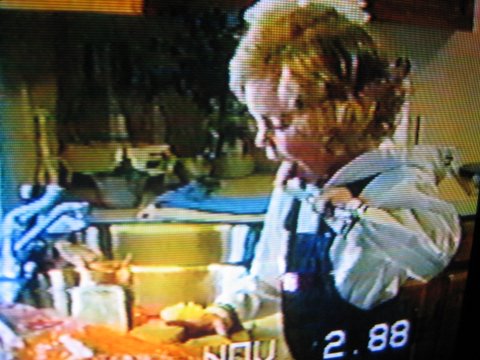 "Then you get some peanut butter and put it on the other side. Then you smooth the peanut butter. I am just getting all the peanut butter off so I can get some more..."
 "Then you put it on..."
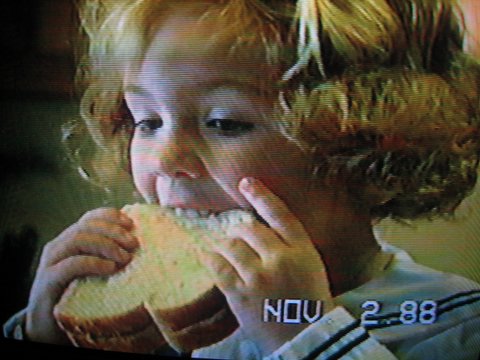 "...and eat it! Mmmmm...I sure do know how to make 'em!"